
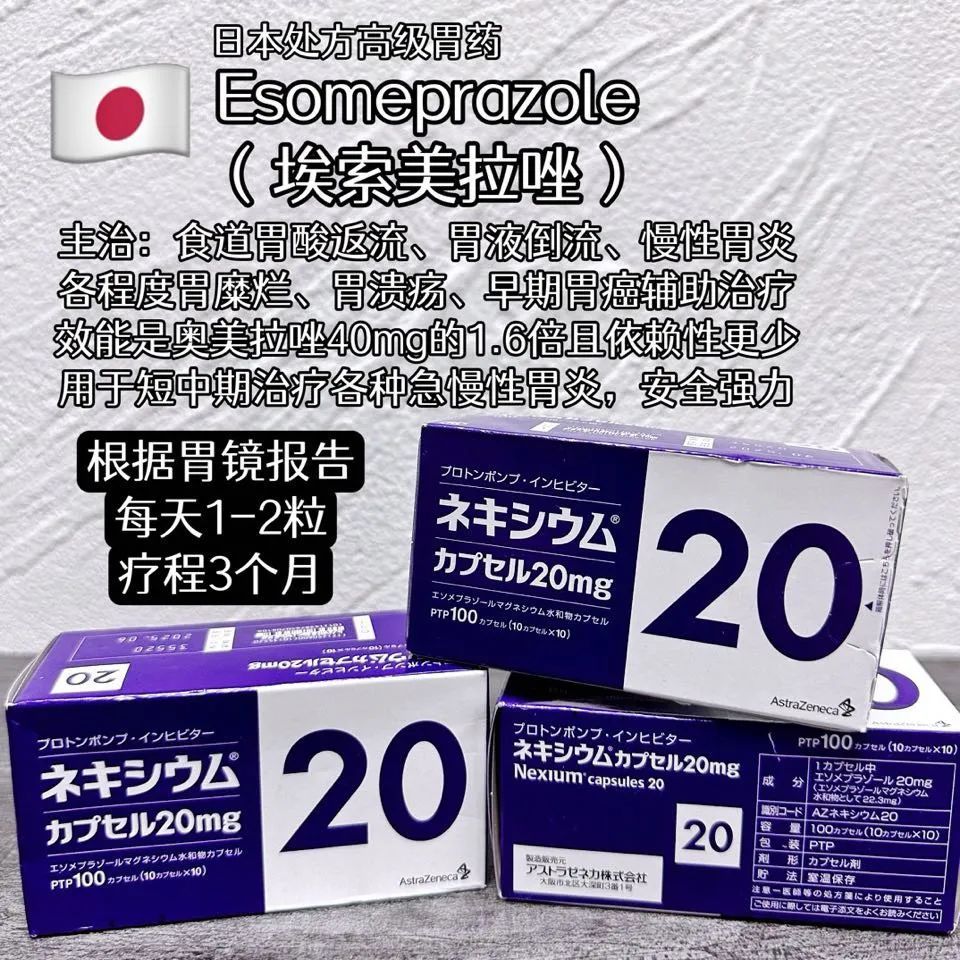
In today's world, where gastrointestinal diseases are prevalent, more and more people are paying attention to their gastrointestinal health. For common gastrointestinal conditions like gastroesophageal reflux disease (GERD) and gastric ulcers, one of the first-choice medications recommended by doctors is "Esomeprazole." This advanced gastric medication, exclusively developed and marketed in Japan and the United States, has been highly favored by patients with stomach issues due to its excellent efficacy and safety.
What is Esomeprazole?
Esomeprazole is the pure S-enantiomer of omeprazole, and it is a new generation of proton pump inhibitors (PPIs). It effectively inhibits the secretion of stomach acid, thereby treating various gastrointestinal diseases.
The mechanism of action of Esomeprazole involves inhibiting the activity of the H+/K+ - ATPase enzyme in the gastric mucosal parietal cells, which prevents acid secretion. Compared to traditional omeprazole, Esomeprazole can achieve faster and more prolonged acid suppression, providing better treatment outcomes for conditions like gastric ulcers and GERD.
Clinical studies have shown that the acid-suppressive effect of Esomeprazole is 1.6 times that of omeprazole, with fewer side effects. In particular, Esomeprazole has been proven to be more effective in treating reflux esophagitis and gastric ulcers, with a cure rate of over 83.7%. This makes it the preferred choice of gastric medication among clinicians.
Why is Esomeprazole only available in Japan and the United States?
Esomeprazole is a new generation of gastric medication developed by a Japanese pharmaceutical company. It was first approved in Japan for the treatment of GERD in 2002, and the U.S. FDA approved it for sale in 2001.
There are several reasons why this excellent gastric medication is only available in Japan and the United States:
High R&D Costs: Developing new drugs requires significant financial investment, with clinical trials alone costing billions of dollars. Only pharmaceutical giants in Japan and the United States, with strong technical and market capabilities, can afford such high R&D costs.
Strict Approval Processes: New drugs must undergo lengthy clinical trials and strict scrutiny by regulatory authorities before they can be marketed. This process typically takes 5-10 years, posing a significant challenge for smaller pharmaceutical companies.
Patent Protection Period: Even if a new drug is successfully developed, it must quickly capture the market within the patent protection period to generate enough profit to offset the high R&D costs. Once the patent expires, generic drugs will flood in, significantly reducing the profit margin due to price competition.
Market Size and Health Insurance Policies: As the world's largest pharmaceutical markets, Japan and the United States provide a broad platform for the promotion of new drugs. Moreover, mature healthcare systems ensure that patients can access high-quality medications at affordable prices. In some emerging markets, inadequate insurance coverage and limited patient affordability restrict the promotion of new drugs.
Therefore, only pharmaceutical powerhouses like Japan and the United States have the capability to bear the high R&D costs of new drugs and gain sufficient returns in their domestic markets. This is the primary reason why Esomeprazole is currently available only in these two countries.
Wide Application of Esomeprazole
As an effective and safe gastric medication, Esomeprazole is widely used in clinical practice.
The most typical application is in the treatment of GERD. GERD is a common digestive system disease characterized mainly by persistent heartburn and acid reflux. If not treated promptly, it can increase the risk of esophageal cancer over time. Most doctors consider Esomeprazole the first-choice medication for GERD, with a cure rate exceeding 83.7%.
In addition to GERD, Esomeprazole plays a crucial role in treating other gastrointestinal diseases:
Gastric Ulcer: Esomeprazole effectively promotes the healing of gastric ulcers and prevents recurrence.
Chronic Gastritis: It improves gastric mucosal lesions by inhibiting acid secretion, achieving therapeutic effects.
Duodenal Ulcer: When combined with Helicobacter pylori eradication therapy, it significantly improves efficacy.
Gastric MALT Lymphoma and Early Gastric Cancer: Used as an adjunctive therapy, it promotes the healing of lesions.
Other Conditions: Such as gastric ptosis, anastomotic ulcers, and symptom improvement.
In summary, with its outstanding efficacy and safety, Esomeprazole has become the clinically recognized "king of stomach medications." It not only alleviates various gastrointestinal symptoms but also effectively cures related diseases, playing an irreplaceable role in protecting gastrointestinal health.
For many patients with stomach issues, having access to high-quality gastric medications like Esomeprazole is a great blessing. Although currently only available in Japan and the United States, it is hoped that with the continuous opening of the global pharmaceutical market, Esomeprazole will gradually be introduced to more countries and regions, benefiting more people.
Let's look forward to the day when this medication will be available worldwide, safeguarding the health of countless patients with stomach conditions!