
If you’ve seen a doctor in Japan for stomach issues like acid reflux or heartburn, there’s a good chance you’ve been prescribed Pariet tablets.
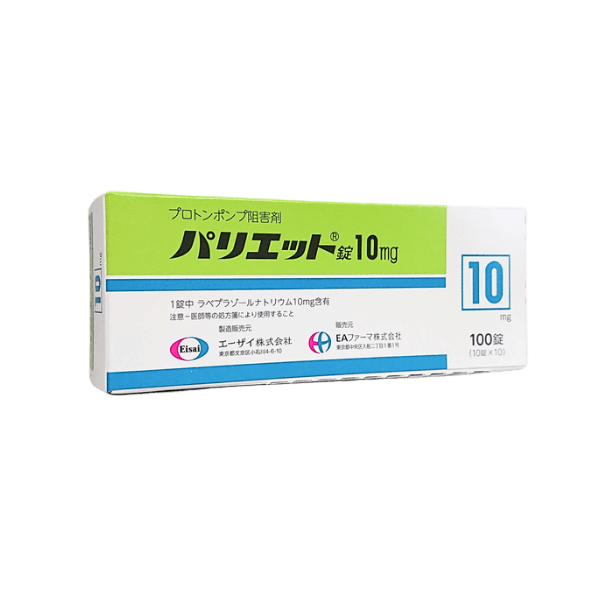
Pariet (Rabeprazole Sodium) 10mg Tablets – 100 tablets
The Chinese name is rabeprazole sodium enteric-coated tablets.
It belongs to a core class of stomach medications:
proton pump inhibitors (PPIs).
Unlike regular stomach meds that just ease symptoms,
this type works at the source—by directly controlling stomach acid production.
A lot of people think stomach discomfort just means a “weak stomach,”
but in reality, many cases are caused by too much acid or acid in the wrong place.
For example, if you often have:
Acid reflux after meals
A burning sensation in your throat when lying down
Chest burning or discomfort
Waking up at night due to acid
These are usually related to stomach acid.
And this is where the medication comes in—
it simply turns down acid production.
Not neutralizing it, but reducing how much is made.
So why does it feel so effective?
It comes down to how it works.
Most regular stomach medicines are like:
→ temporarily suppressing symptoms
But this one:
→ controls the “acid production switch”
Once that’s suppressed:
Acid levels drop significantly
The effect lasts much longer (often covering a full day)
That’s why after a few days, many people feel like:
“Everything feels better—not just my stomach.”
What does it feel like in real use?
From actual user experience:
In the first week, most people notice:
Less acid reflux
Reduced pressure or discomfort in the stomach
Better sleep
But one thing to keep in mind:
→ it doesn’t work instantly, it stabilizes over time
Usually, you start noticing clear improvement after 2–3 days.
How should you take it?
This is where many people get it wrong.
Typically:
→ once a day, in the morning, on an empty stomach
Why?
Because it works best before acid production begins.
If you take it after meals,
the effect may be weaker.
Can it be taken long-term?
Short answer:
→ not on your own.
Short-term use (a few weeks) is generally fine.
But if you find yourself:
Taking it whenever discomfort appears
Relapsing as soon as you stop
Using it continuously for months
Then you should be more cautious.
Long-term acid suppression may:
Affect digestion
Reduce calcium and vitamin B12 absorption
Alter gut balance
It’s not that it can’t be used long-term—
but it should be under medical guidance.
One common mistake:
People treat it as a “universal stomach remedy.”
But in reality:
→ it’s mainly for acid-related problems
If your issue is:
Simple indigestion
Bloating or burping
Occasional discomfort
This may not be the right choice.
In some cases, testing is more important than medication.
If you have:
Long-term reflux (months)
Worse symptoms at night
Relief with medication, but quick relapse
You should consider:
→ an endoscopy
→ a Helicobacter pylori test
Many people delay this and rely only on medication.
One more common question:
Can it be taken with other stomach meds?
Generally yes, depending on the type, such as:
Antacids (for quick relief)
Mucosal protective agents
But if you’re combining medications yourself,
it’s best to check with a doctor or pharmacist.
To put it simply:
Pariet (rabeprazole 10mg) is essentially
→ a treatment tool, not a casual remedy.
It’s not a supplement,
and not something to take casually whenever you feel discomfort.
Its real value is:
✔ keeping acid levels under control
✔ giving your stomach time to recover
But if you find yourself unable to stop taking it,
the issue may not be the medication—
but the underlying condition.